Guide brief
The clean split
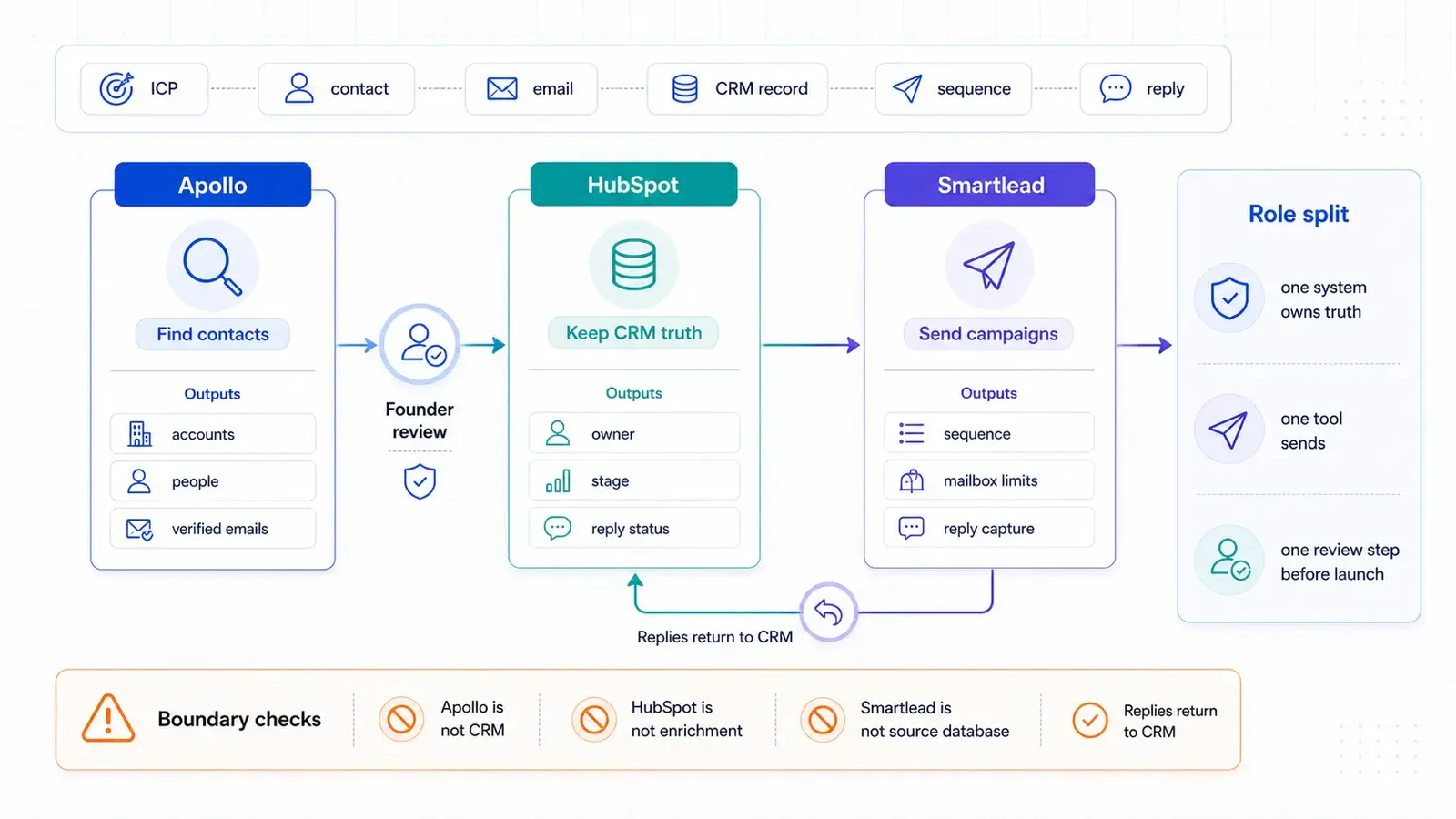
In a founder-led outbound stack, Apollo finds candidates, HubSpot holds truth, and Smartlead sends approved outreach. That is the practical split. Each product can do more, but the stack stays cleaner when each owns one primary decision layer.
This matters for STK-A002 because the founder is still learning. The system should show the record path clearly: where the contact came from, why it was approved, what message was sent, and what happened after the reply.
Apollo owns candidate discovery
Apollo is best used as the prospecting source. It helps a founder find accounts, people, titles, and emails for a narrow segment. Its job is to create a candidate pool for review, not to become the place where long-term account history or campaign outcomes live.
- Use Apollo for: account search, contact discovery, title filters, email data, and first-pass list building.
- Do not use Apollo for: final owner status, opt-out truth, open opportunity suppression, or reply history.
- Founder check: would you still approve this account if it appeared outside the Apollo list?
HubSpot owns CRM truth
HubSpot is the least optional layer because it keeps memory. If a founder-led system sends from Smartlead and sources from Apollo but does not write outcomes back to HubSpot, nobody can tell what happened a month later. That makes follow-up, reporting, and handoff harder than they need to be.
- Use HubSpot for: owner, lifecycle, source, approval status, exclusion reason, campaign status, reply outcome, and next action.
- Do not use HubSpot for: dumping every raw Apollo record before it has a reason to exist in the CRM.
- Founder check: can you open the HubSpot record and understand the send decision without checking three other tools?
The minimum HubSpot fields
The lean field set is small: source segment, owner, approval status, reason to contact, sequence status, reply outcome, exclusion reason, and next action. If those fields are missing, adding more automation will only move confusion faster.
Smartlead owns sending and reply capture
Smartlead should receive records after discovery and review. It owns campaign execution, sending cadence, mailbox management, sequence activity, and reply capture. It should not become the long-term source of account truth.
- Use Smartlead for: approved sequences, mailbox execution, sender groups, replies, bounces, opt-outs, and campaign activity.
- Do not use Smartlead for: deciding whether the account belongs in the CRM or what the long-term owner should do next.
- Founder check: does every important Smartlead outcome update HubSpot quickly enough for follow-up?
What should move between tools
The stack should sync only the fields that affect eligibility, message delivery, and follow-up. Moving every available field creates maintenance work. Moving too few fields creates blind spots. The useful middle is a small handoff contract.
- Apollo to HubSpot: company, person, title, email, source segment, and discovery date.
- Founder review to HubSpot: approval status, reason to contact, rejection reason, and next action.
- HubSpot to Smartlead: approved email, variables, sender group, suppression status, and campaign membership.
- Smartlead to HubSpot: reply, bounce, opt-out, meeting booked, not interested, and campaign completed.
HubSpot Sequences vs Smartlead
The HubSpot Sequences vs Smartlead comparison is the main decision point. If the founder needs very low volume and CRM simplicity, HubSpot Sequences may be enough. If the motion needs dedicated mailbox control, outbound cadence, and reply handling, Smartlead is usually the cleaner sending layer.
Either way, the principle stays the same: sending can happen outside HubSpot, but truth should return to HubSpot. The sender dashboard is not a substitute for the record the team will use later.
Common failure patterns
- Apollo bypasses exclusions: a prospect enters a sequence even though HubSpot has an open deal, customer status, opt-out, or bad-fit note.
- Smartlead becomes the memory layer: the campaign shows replies, but HubSpot does not show outcomes or next actions.
- HubSpot gets polluted: every raw Apollo contact enters the CRM before the founder has approved the segment.
- Zapier moves vague fields: the workflow copies data without a rule for which system is allowed to edit it later.
Weekly audit for the founder
Once the split is live, the founder should audit the path weekly. Pick five Apollo-sourced records, five HubSpot records that entered a campaign, and five Smartlead replies. Check whether the same story appears in all three places. If the source, approval, send status, and reply outcome do not line up, fix the field contract before adding more volume.
This audit is small enough to keep doing. It catches the failures that dashboards hide: a bad-fit account that bypassed review, an opt-out that did not sync, or a reply that stayed in the sender while the CRM looked quiet. Those misses matter before outbound volume rises quickly.
FAQ
Can HubSpot replace Smartlead?
Sometimes. If the founder sends low volume and wants all activity inside the CRM, HubSpot may be enough. Smartlead is stronger when outbound sending needs dedicated mailbox and cadence control.
Can Apollo replace HubSpot?
No, not for this stack. Apollo can source candidates, but HubSpot should hold ownership, lifecycle, exclusions, and long-term outcome history.
What is the first automation to build?
Start with outcome writeback from Smartlead to HubSpot. If replies, bounces, opt-outs, and meetings do not return to CRM truth, the founder cannot learn reliably from the campaign.
Bottom line
The founder-led stack does not need many tools, but it does need clean ownership. Apollo discovers, HubSpot remembers, Smartlead sends, and every handoff should be small enough for the founder to audit.