Guide brief
Quick answer
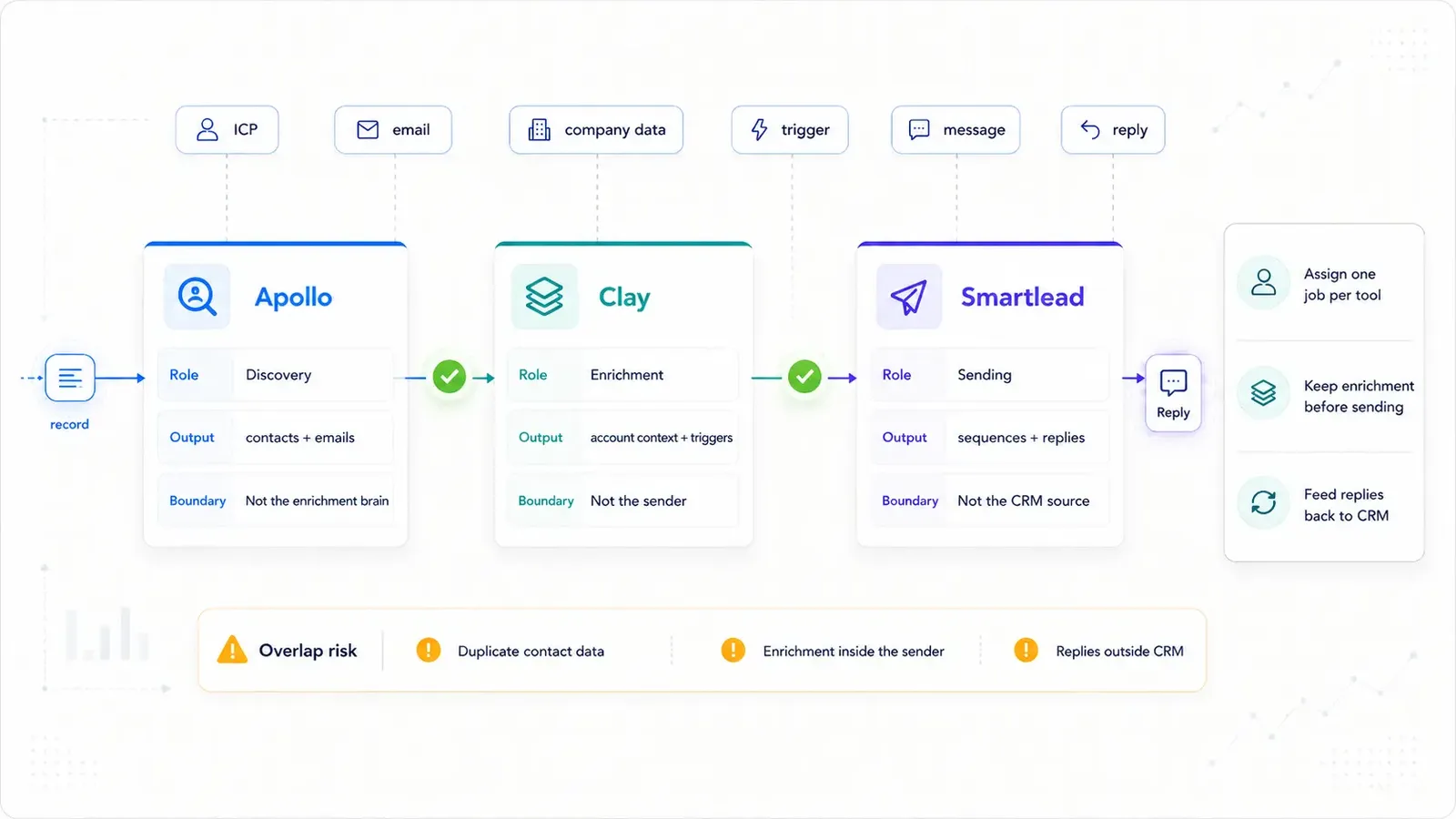
In a clean outbound stack, Apollo discovers the pool, Clay sharpens selected records, and Smartlead sends approved audiences. That role split is more useful than asking which tool is "better." These products overlap at the edges, but they should not all own the same operational truth.
Use the full role split in STK-A001 when you need a practical model: source and discover, enrich and review, move through workflow rules, send, capture replies, then update CRM truth.
Apollo: discovery, not the enrichment brain
Apollo is strongest when it starts the motion: finding accounts and contacts, estimating coverage, and giving the team a broad prospecting base. It can support basic filtering and contact data, but the stack becomes brittle if Apollo is asked to own every research judgment.
- Primary job: find contacts and verified emails for the target segment.
- Useful output: candidate accounts, contact records, titles, and email data.
- Boundary: do not make Apollo the place where nuanced account context, triggers, and approval history live.
Clay: enrichment and evidence, not the sender
Clay earns its place when the team needs selective enrichment: account context, trigger evidence, firmographic checks, role-specific personalization fields, and research workflows that decide whether a record deserves outreach. It is a powerful layer, which is exactly why it needs boundaries.
- Primary job: turn selected records into better-qualified, better-evidenced records.
- Useful output: context fields, triggers, fit checks, snippets for review, and qualification flags.
- Boundary: do not let Clay become a shadow CRM with unreviewed truth that never returns to the system of record.
Smartlead: sending and reply activation, not the source database
Smartlead should receive records after discovery, enrichment, and review have done their work. Its job is sending, mailbox management, campaign execution, and reply handling. If strategic segmentation or enrichment lives only inside the sender, the team loses visibility when the campaign ends.
- Primary job: send approved campaigns safely and capture outcomes.
- Useful output: sequence activity, reply signals, booked meetings, and sender-level delivery health.
- Boundary: do not treat Smartlead as the master source for status, ownership, or long-term account history.
Where overlap creates mistakes
Apollo vs Clay
The overlap appears around contact data and filters. If both tools are sourcing and enriching the same record independently, teams end up with duplicate fields and unclear confidence. Let Apollo create the candidate pool, then let Clay add selected evidence only where it changes the decision.
Clay vs Smartlead
The overlap appears around personalization and campaign logic. Smartlead can hold variables, but the reviewable evidence behind those variables should live upstream. Keep the sender lean: approved audience in, controlled send out, replies back to CRM.
How to choose what to buy first
If the team has no reliable contact source, start with discovery. If it has contact data but weak account context, start with enrichment. If it already has approved audiences and needs controlled sending, start with the sender. Buying all three at once is reasonable only when someone is ready to own the handoffs between them.
- Start with Apollo when the main constraint is finding enough relevant contacts in the right segment.
- Start with Clay when the main constraint is deciding which records deserve outreach and why.
- Start with Smartlead when the main constraint is sending approved audiences safely and tracking replies.
The minimum clean handoff
A workable handoff has fewer fields than people expect. The sender does not need every research artifact. It needs the approved audience, the message variables, suppression status, and any guardrails that affect sending. The CRM needs more: source, owner, lifecycle status, last touch, reply outcome, and enough evidence to reconstruct the decision later.
That is why the best Clay, Apollo, and Smartlead setup usually has a workflow layer between enrichment and sending. The workflow does not need to be complex. It needs to decide what moves, what waits for approval, what is rejected, and what gets written back after the campaign.
A simple ownership rule
Assign one job per tool and one place for truth. If two tools can edit the same decision field, the stack needs a rule before it needs another automation. That rule is what keeps a Clay plus Apollo plus Smartlead setup from turning into three disconnected databases.