Guide brief
Quick decision
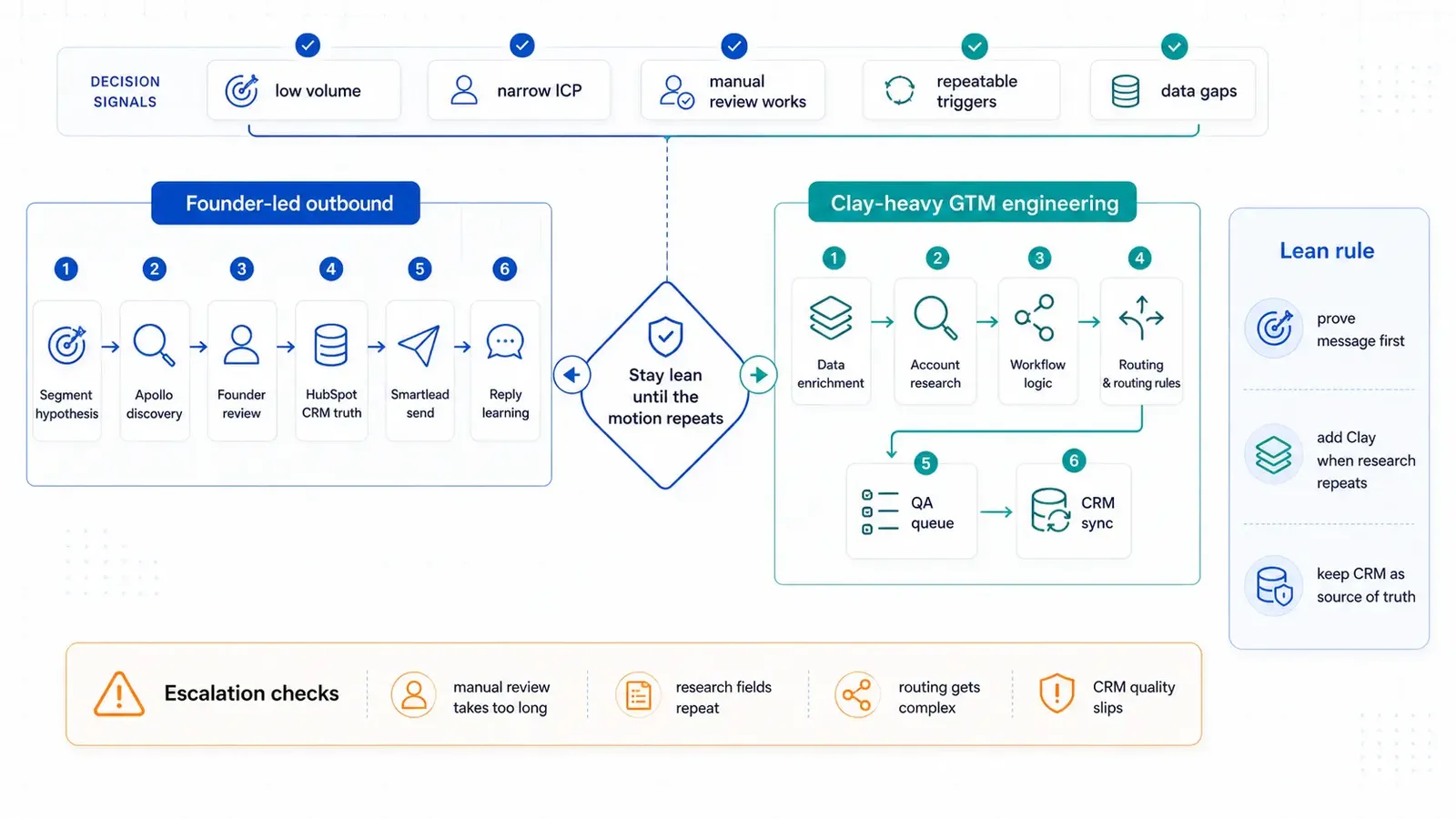
Stay with founder-led outbound when the company is still learning the market. Move toward a Clay-heavy GTM engineering stack when the motion is already known and the bottleneck is scale, enrichment depth, or workflow control. The mistake is not choosing the lean path. The mistake is pretending a heavier system can prove an unproven hypothesis.
The lean stack answers "what should we learn?" The heavier stack answers "how do we run this known motion with more control?" Those are different jobs, and mixing them too early creates expensive noise.
What founder-led outbound is better at
Founder-led outbound is better when the founder still needs to inspect the market directly. The campaign is partly a sales motion and partly research. The founder is testing whether the account segment is right, whether the pain is urgent, whether the offer lands, and which replies deserve a product or positioning change.
- Best operating mode: small batches, close review, low workflow complexity, fast message edits.
- Best owner: a founder or first GTM owner who can translate replies into decisions.
- Best evidence: real replies, rejected accounts, objection patterns, and clearer exclusion rules.
- Main risk: manual maintenance becomes the hidden cost if the motion starts repeating.
What Clay-heavy GTM engineering is better at
A Clay-heavy GTM engineering stack is better when the team has a repeatable decision rule and needs more research depth, routing, orchestration, or enrichment scale. It is useful when account context changes the send decision often enough to justify the extra logic.
- Best operating mode: stable ICP, documented enrichment rules, stronger QA, and higher record movement.
- Best owner: RevOps or a GTM engineer who can maintain fields, workflow logic, and failure handling.
- Best evidence: a known motion where richer account context improves prioritization or message relevance.
- Main risk: building a research factory before the campaign thesis is worth scaling.
The false upgrade
The false upgrade happens when a team buys complexity to feel more serious. They add enrichment tables, conditional routing, and custom workflows, but the founder still changes the segment every week. The result is maintenance for a moving target.
Stay lean when these signals are true
- The founder still rewrites the ICP after reading replies.
- The team cannot name the enrichment field that changes the send/no-send decision.
- HubSpot has unclear status, owner, source, or exclusion fields.
- The best feedback is still qualitative, not a stable conversion pattern.
- Manual review is still catching mistakes before volume causes damage.
In this state, lean is not less ambitious. It is more honest. The system should keep the founder close enough to correct the motion quickly instead of turning early guesses into automated policy.
Move heavier when these signals are true
Use the STK-A002 vs STK-A004 comparison when the team sees enough repeatability to justify the extra operating model. Then look for practical signals.
- The ICP, exclusions, and qualification rules have stayed stable across multiple batches.
- Research fields change prioritization often enough to be worth maintaining.
- A RevOps or GTM engineering owner can support workflow failures and field drift.
- The CRM can receive enriched fields without becoming noisy or untrusted.
- The team needs larger batches, multiple segments, or more precise routing than founder review can support.
Decision review template
Before migrating, run a short review. If the answers are weak, stay lean for another cycle.
- Decision rule: what exact rule will the heavier stack automate or improve?
- Evidence: which real records prove that rule matters?
- Owner: who will maintain the enrichment fields, workflow failures, and CRM writes?
- Failure cost: what breaks if the workflow sends or enriches the wrong records?
- Exit criteria: what result would tell the team to simplify again?
The cost of moving too early
Moving too early creates a quiet tax. Someone has to maintain enrichment tables, explain custom fields, repair failed runs, and debug why a record reached the sender. If the campaign thesis is still shifting, that work supports yesterday's idea instead of a proven motion.
A useful checkpoint is simple: can the team review twenty sent records and agree on why each record was selected, what evidence mattered, and which next step should happen after the reply? If not, improve the lean decision rule first.
Migration proof pack
Before approving the heavier path, collect a proof pack. It should include ten records that would clearly benefit from deeper enrichment, five records that should be rejected by a rule, three examples where manual research changed the message, and one failed handoff that a workflow would prevent. If the team cannot assemble that evidence, it is probably trying to buy confidence instead of scale a working rule.
The proof pack also protects the future owner. A GTM engineer or RevOps lead can maintain a Clay-heavy system when the rule is observable. They cannot maintain a vague founder instinct disguised as automation.
FAQ
Is Clay-heavy always better for personalization?
No. Better personalization starts with knowing what evidence matters. If the founder cannot say which account facts change the message, deeper enrichment can produce longer copy without a better decision.
When is the lean stack too small?
It is too small when manual review blocks a proven motion, CRM rules are clear, and the team repeatedly needs the same enrichment or routing logic. That is a systems problem, not a founder-learning problem.
Bottom line
Stay lean until the learning loop is repeatable. Move to Clay-heavy GTM engineering when the issue is no longer discovering the motion, but controlling and scaling a motion the team already understands.