Guide brief
Short answer
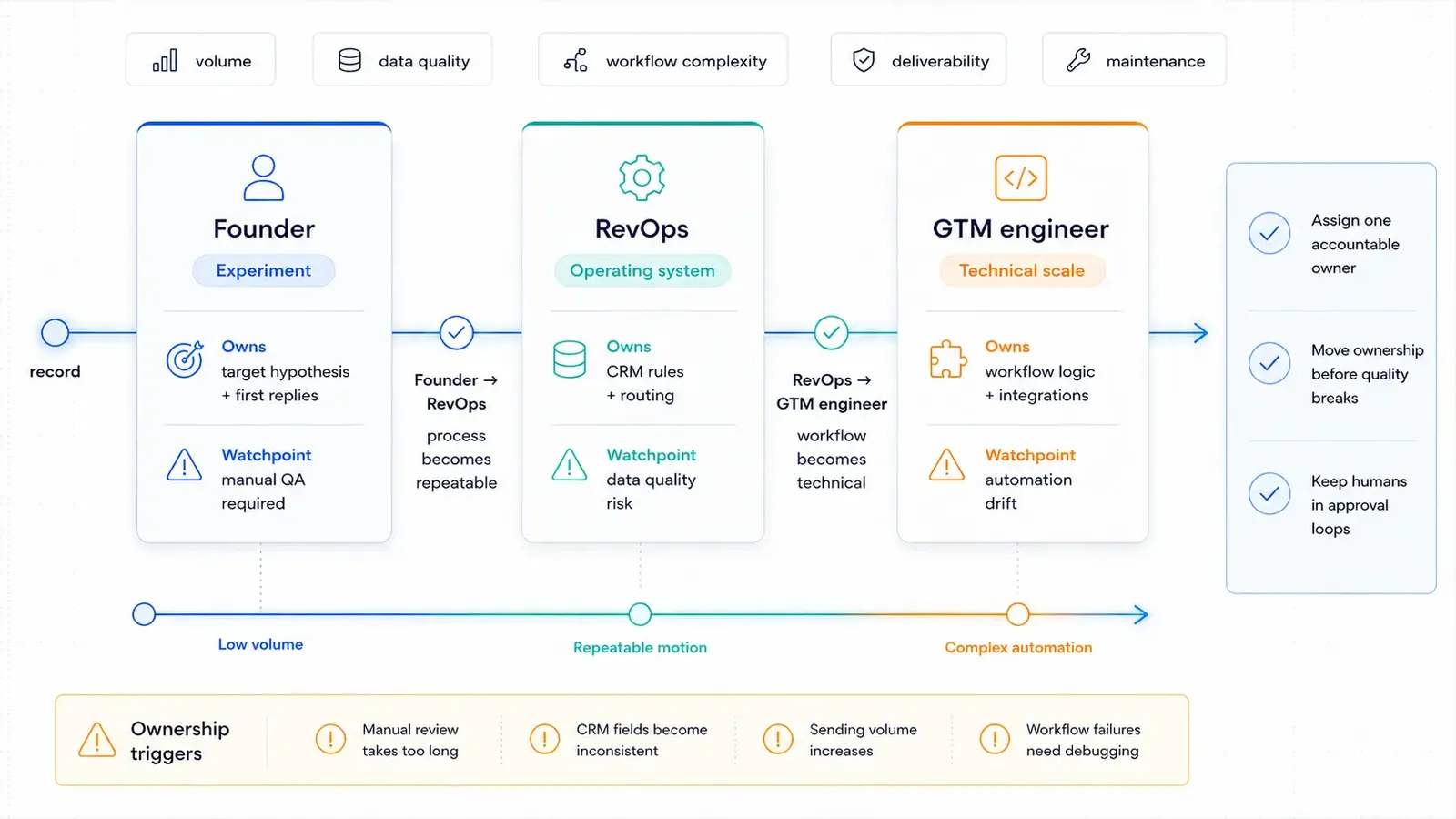
Outbound automation should change owners as the motion matures. The founder should own the experiment, RevOps should own the operating system, and a GTM engineer should own technical scale. A single permanent owner sounds tidy, but it usually ignores how outbound work changes after the first replies arrive.
The right question is not "who likes automation?" It is "which decision is currently most fragile?" If the target hypothesis is fragile, keep the founder close. If data quality and routing are fragile, move to RevOps. If integrations and workflow logic are fragile, bring in GTM engineering.
Founder ownership: useful during the experiment
A founder should own outbound automation when the market, ICP, offer, and message are still being tested. At that stage, the highest-value work is judgment: which accounts are worth contacting, what reply patterns mean, and which pain points are real enough to build around.
- Owns: target hypothesis, message direction, first replies, and the decision to continue or stop a segment.
- Watchpoint: manual review takes too long, feedback stays in notes, or the founder becomes the only person who understands the logic.
- Handoff signal: the process is repeating and the team needs cleaner CRM fields, routing, and reporting.
RevOps ownership: necessary once the motion repeats
RevOps should own the system when outbound becomes a weekly operating motion. This is where CRM rules, lifecycle status, field hygiene, dedupe, routing, suppression, and reporting start to matter more than the first clever workflow.
- Owns: CRM truth, data quality rules, routing, status definitions, approval flow, and operating cadence.
- Watchpoint: fields become inconsistent, sales does not trust statuses, or replies do not update the right records.
- Handoff signal: workflow logic becomes too technical for normal RevOps maintenance.
GTM engineering ownership: required for technical scale
A GTM engineer or systems builder should own the stack when the workflow needs durable integrations, branching logic, error handling, API work, or careful orchestration between tools. At that point, the stack is no longer just a campaign process. It is production-like infrastructure for a revenue motion.
- Owns: workflow logic, integration reliability, webhook/API behavior, monitoring, and edge-case handling.
- Watchpoint: automation drift, silent failures, brittle scripts, or sending volume increasing faster than QA.
- Success signal: RevOps can still understand the rules, while engineering keeps the system reliable.
Handoff triggers
Move ownership before quality breaks. These are the triggers that usually mean the current owner model is done.
- Manual review takes too long for the volume you want to send.
- CRM fields become inconsistent across campaigns or owners.
- Sending volume increases and deliverability checks become a weekly concern.
- Workflow failures need debugging instead of simple admin fixes.
- Nobody can explain why a record entered a campaign or what happened after the reply.
When to bring in a GTM engineer
Bring in GTM engineering when the workflow has to behave like reliable infrastructure: retries, branching logic, API limits, monitoring, and failure handling. RevOps should still own the operating rules, but engineering should own the parts that break silently if nobody is watching logs.
A practical ownership cadence
Ownership is not only a name in a planning doc. It should show up in a recurring review. In the early version, that review can be short: inspect records, check bad-fit sends, review reply outcomes, and decide which rule changes before the next batch. Once the motion scales, the review should also cover deliverability, field drift, workflow failures, and source quality.
- Founder review: message learning, segment quality, first reply patterns, and whether the offer is worth scaling.
- RevOps review: CRM fields, status definitions, routing rules, dedupe, owner handoff, and reporting trust.
- GTM engineering review: workflow reliability, integration errors, API limits, logs, retries, and silent failure risk.
What not to do
Do not split ownership by tool without assigning ownership of the record path. A founder owning Apollo, RevOps owning HubSpot, and a contractor owning Clay can still leave nobody responsible for the system. The owner should be accountable for the outcome across tools: whether the right records move, the wrong records stop, and the CRM reflects reality.
Keep one accountable owner
Even when several roles contribute, one person should own the system at any moment. Committees do not maintain outbound automation; accountable owners do. The owner can change, but the record path, approval rules, and CRM truth should never be ownerless.
For the practical stack path, start with STK-A001 and use the ownership handoff as a scale guardrail, not an afterthought.