Guide brief
Short answer
A founder-led outbound automation stack is a small, inspectable system for learning which accounts, pains, and messages deserve a repeatable sales motion. It automates the drag around discovery, CRM updates, sending, and reply capture without removing the founder from the buyer signal.
For AIAutomationStacks, that pattern is STK-A002, the Founder-Led Outbound Lite Stack. It is not a miniature enterprise RevOps build. It is a learning loop with just enough structure to avoid spreadsheet chaos: candidate records in, founder judgment applied, approved messages sent, replies returned to CRM truth.
What this stack is really for
The purpose is not to create the largest possible outbound machine. The purpose is to answer a narrow market question: which accounts respond to this offer, and what does their response teach the founder? That is why the first version should be easy to audit. A founder should be able to open a record and understand why it entered the campaign, what message it received, and what happened next.
The best founder-led stack makes learning faster without making judgment invisible. If the founder cannot see the logic anymore, the system is already too heavy for this stage.
The minimum operating path
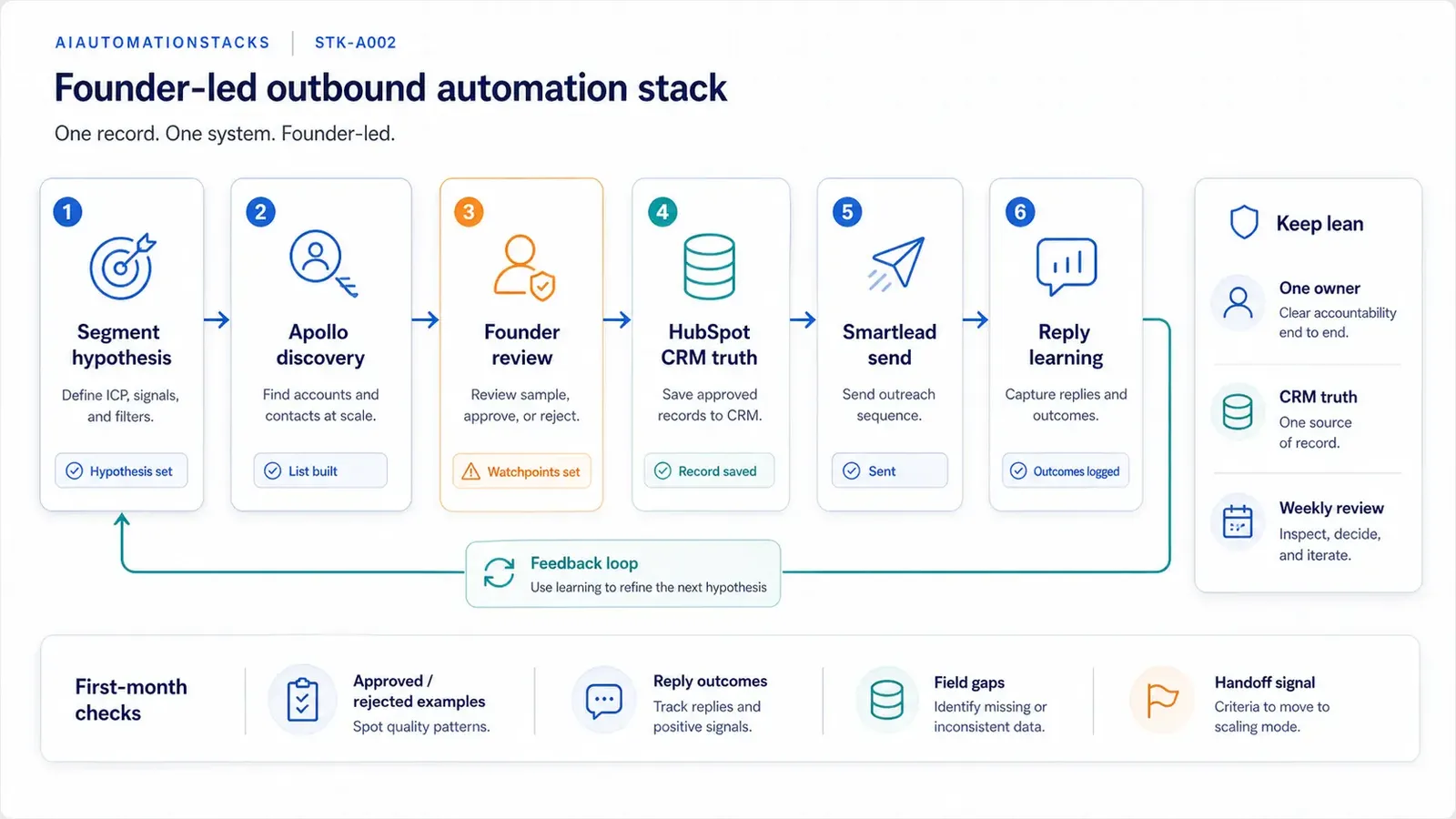
A useful STK-A002 path has six jobs. The tools can change later, but the jobs should stay clear.
- Segment choice: the founder defines one narrow ICP, exclusion rules, and a reason to test it now.
- Discovery: Apollo finds candidate accounts, contacts, titles, and emails for that segment.
- CRM truth: HubSpot stores owner, source, approval status, lifecycle, exclusions, and reply outcomes.
- Founder review: the founder approves or rejects records before they enter a sequence.
- Sending: Smartlead sends approved audiences with controlled volume and sender monitoring.
- Feedback loop: reply, bounce, opt-out, and meeting outcomes return to HubSpot for follow-up and learning.
The test for tool creep
Before adding another tool, ask what decision it improves. If the answer is vague, do not add it. If the answer is specific - for example, "we need a required disqualification reason before sending" - add the smallest field or workflow that supports that rule.
The field contract that keeps it sane
Most founder-led stacks fail because the fields are not boring enough. The founder remembers context in their head, Apollo has a list, Smartlead has sequence activity, and HubSpot has partial truth. The fix is not a bigger architecture diagram. It is a small field contract everyone respects.
- Source segment: where the record came from and which test it belongs to.
- Approval status: approved, rejected, needs review, or hold.
- Reason to contact: the one-sentence evidence behind the send decision.
- Exclusion reason: customer, open opportunity, bad fit, competitor, opt-out, or duplicate.
- Sequence status: not enrolled, active, paused, replied, bounced, or completed.
- Reply outcome: interested, not now, referral, objection, meeting, opt-out, or bad fit.
First-month scorecard
The first month should not be judged only by meetings booked. Meetings matter, but the better question is whether the founder can make sharper decisions after the campaign. A strong first month produces a clearer segment, better exclusions, repeat objections, and a few messages worth testing again.
- Good signal: reply patterns explain why a segment is worth another controlled batch.
- Weak signal: opens and clicks exist, but replies do not teach anything about pain, timing, or buyer fit.
- Operational signal: the team can audit twenty sent records and reconstruct the decision path without asking the founder from memory.
Publication-quality examples to capture
The founder should capture examples while the batch is still fresh. Pick three accounts that clearly belonged in the campaign, three that should have been excluded, three replies that taught something, and three records where the tool handoff was confusing. Those examples become the source material for better fields, better message rules, and eventually a cleaner RevOps handoff.
This sounds like editorial work, but it is operational hygiene. Without examples, the team debates abstractions. With examples, the founder can say exactly what "good fit", "hold", "bad fit", "not now", or "needs review" means inside the working stack.
When the stack is ready to hand off
A founder-led stack should not stay founder-owned forever. It is ready for RevOps when the founder can explain the target rule, message angle, approval standard, and reply taxonomy with real examples. At that point the job becomes operating quality: fields, routing, suppression, sender safety, and weekly review cadence.
Use the Founder-Led Outbound Lite Stack Playbook to make that handoff visible before scale. The playbook should capture what the founder learned, not ask RevOps to reverse-engineer it from tools.
FAQ
Is this just a cheaper outbound stack?
No. It is lean because the decision stage is different. A founder-led stack optimizes for learning quality and fast correction, not maximum workflow sophistication.
Should the founder write every email?
Not necessarily. The founder should own the message hypothesis and review reply patterns. Writing every line by hand is less important than staying close to why buyers respond or ignore the campaign.
What is the main failure mode?
The main failure mode is scaling a vague assumption. If the stack sends more records before the founder has clarified segment, evidence, and reply outcomes, it creates activity without learning.
Bottom line
A founder-led outbound automation stack is a controlled learning system. Keep the tool split simple, write down the CRM field contract, review real replies, and hand off only when the operating rules are clear enough for someone else to maintain.