Guide brief
Quick answer
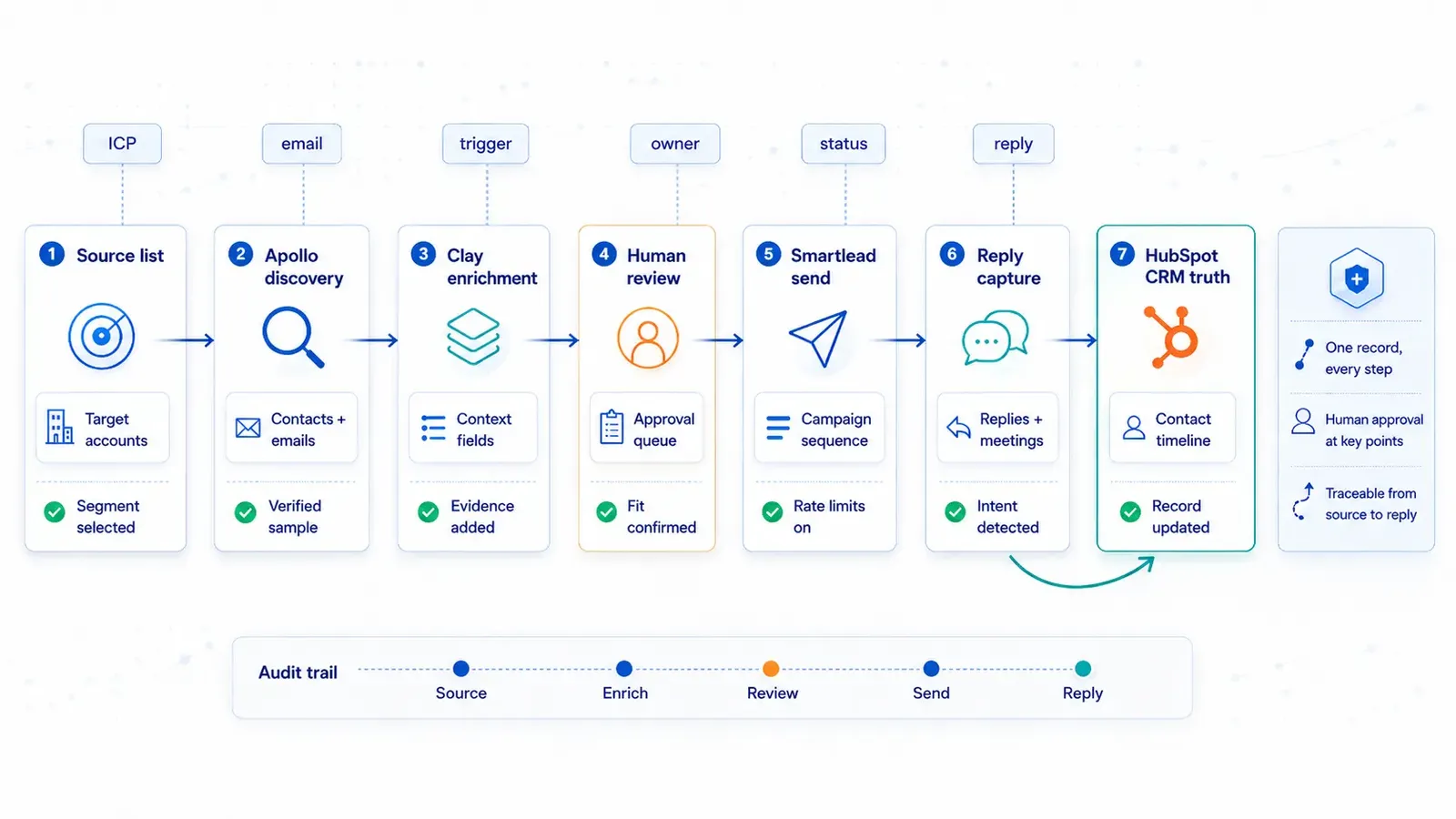
An AI outbound automation stack is the operating path a target account or contact follows from source list to discovery, enrichment, approval, sending, reply capture, and CRM update. The useful definition is not "we use Clay plus a sender." The useful definition is: one record, one owner, every step visible.
That distinction matters because most messy outbound systems do not fail at the tool level. They fail when nobody can explain which field is trusted, who approved the account, why a prospect was sent a message, or whether the reply made it back to the CRM. The stack exists to make those handoffs repeatable.
What belongs in the stack
For STK-A001-style outbound, the stack usually has seven jobs. The vendor names can change, but the jobs should not blur together.
- Source list: the ICP segment or account pool you are willing to contact.
- Discovery: the contact and email finding layer, often Apollo or a similar database.
- Enrichment: selective account context, trigger evidence, and qualification fields before a message is sent.
- Human review: approval for fit, relevance, and message direction before volume increases.
- CRM truth: the system of record that keeps ownership, status, history, and exclusions clean.
- Sending and replies: the sequence tool plus reply capture, meeting signals, and suppression logic.
Where STK-A001 draws the line
The SMB Outbound Velocity Stack is intentionally conservative. It treats Apollo as discovery, Clay as enrichment, n8n as controlled movement, Smartlead as sending, Reply as capture, and HubSpot as CRM truth. That role split is less glamorous than an "AI sales agent" promise, but it is easier to audit.
The goal is not to automate every judgment. The goal is to automate movement after the judgment has somewhere to live. A founder, RevOps lead, or GTM engineer can then ask simple questions: Who owns this record? Which field triggered the send? What evidence did the reviewer see? Did the reply update the same record?
The practical test
Before calling a set of tools a stack, walk one contact through the path and check whether the answers are obvious.
- Where did this account enter the system?
- Which tool added contact data, and which tool added context?
- Who approved the account or message before sending?
- Which CRM field changed after the reply?
- Can the same path run again next week without rebuilding the spreadsheet?
When the stack is not ready
A team should not rush into outbound automation just because the tools are available. If the ICP changes every few days, if the CRM has no clear lifecycle fields, or if nobody can name the person responsible for suppressions and bad-fit accounts, the system will create noise faster than pipeline.
The better move is to run a small reviewed motion first: one segment, one discovery source, one enrichment path, one approval step, one sending path, and one CRM update rule. That version will feel slower than a fully automated workflow, but it will reveal the fields and decisions the full stack must protect.
Minimum viable version
- A named ICP segment with exclusions, not just a broad list of companies.
- A required evidence field before a record can enter outreach.
- A human approval step for the first batch of accounts and messages.
- A reply outcome field that updates the CRM record, not only the sender dashboard.
How to measure the first version
The early measurement should focus on control, not only reply rate. Can the team audit five random sent records and understand why each one moved? Are bad-fit records being suppressed before they reach the sender? Are replies, bounces, meetings, and opt-outs reflected in the CRM? These checks tell you whether the stack is becoming an operating system or just another campaign launcher.
What usually goes wrong
The common failure mode is overlap disguised as sophistication. Apollo starts acting like the strategy layer, Clay becomes a second CRM, Smartlead holds operational truth, and reply outcomes live outside the system the team actually reports from. Once that happens, more automation only makes the mess move faster.
A cleaner stack keeps enrichment before sending, keeps approval before scale, and keeps CRM updates after replies. If the record cannot be traced, the stack is not ready to scale.
Bottom line
An AI outbound automation stack is best understood as a controlled record path. Tools matter, but tool order, data ownership, and review points matter more. Start with the path, then choose the tools that can respect it.