Guide brief
Short answer
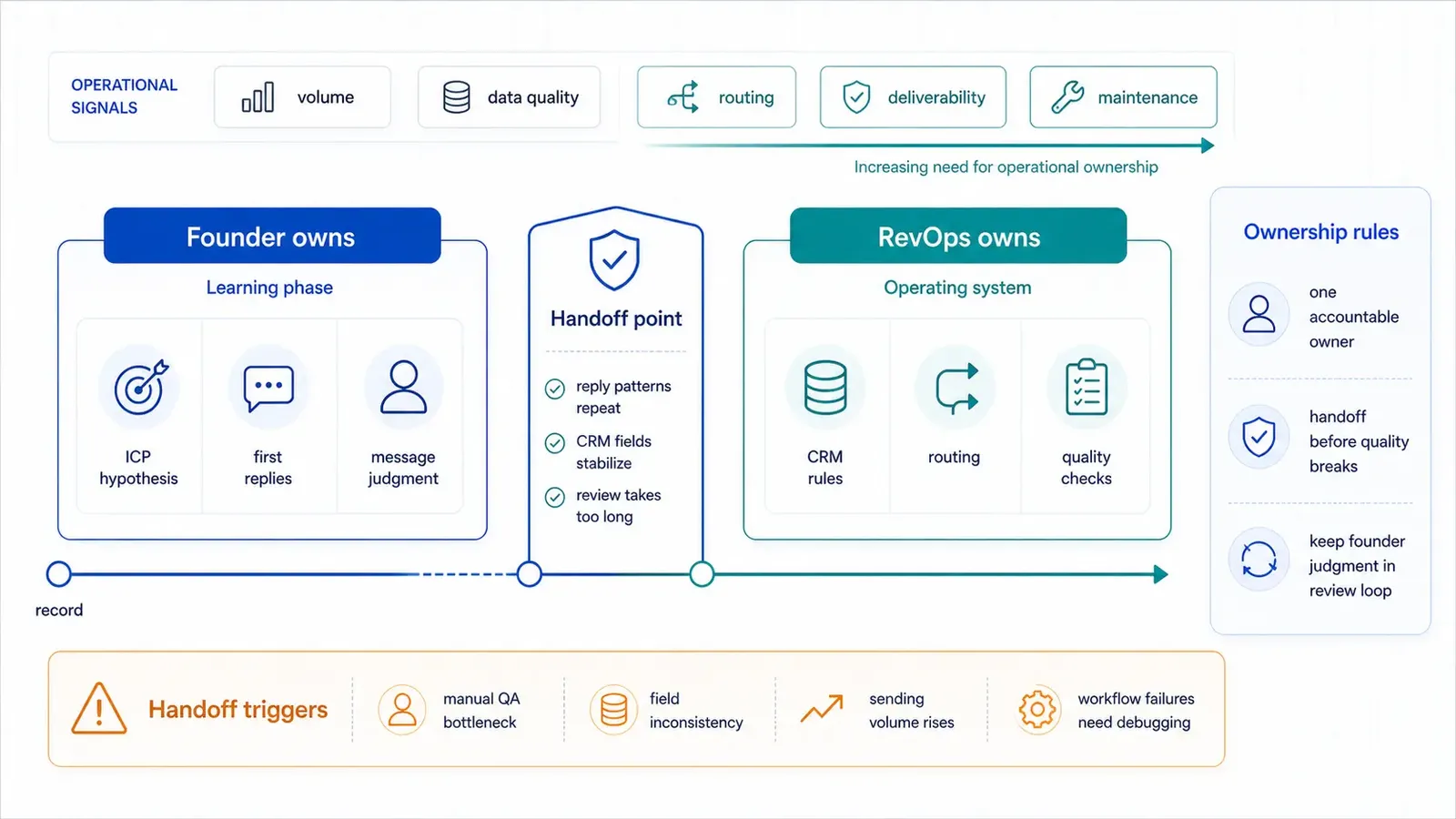
A founder should hand off outbound automation to RevOps when the motion is repeatable enough to operate, but fragile enough that inconsistent ownership will damage it. The handoff point is when the main risk stops being market learning and starts being system quality.
In the Founder-Led Outbound Lite Stack, the founder owns the early judgment: who to contact, why the message matters, and what replies mean. RevOps takes over when those judgments can be converted into CRM fields, suppression rules, routing, and weekly QA.
What the founder should keep owning
The founder should not disappear the moment the stack starts working. Early outbound is still product and market learning. The founder should stay close to the parts that require taste, judgment, and willingness to change the hypothesis.
- Target hypothesis: which accounts are worth testing and why the timing matters.
- Message angle: which pain, trigger, or promise is being tested in the campaign.
- Reply learning: what objections, referrals, meeting reasons, and dead ends say about the market.
- Stop/go decision: whether a segment should continue, pause, narrow, or move into a different motion.
What RevOps should take over
RevOps should own the operating system once the motion has enough repeatability. That means protecting the database, rules, and reporting from drift. RevOps is not there to invent the founder hypothesis; RevOps is there to make the proven parts durable.
- CRM field ownership: source, owner, approval status, lifecycle, exclusion reason, sequence status, and reply outcome.
- Data quality: dedupe, opt-out handling, bad-fit suppression, and cleanup of incomplete records.
- Routing: who owns replies, meetings, no-shows, referrals, and follow-up actions.
- Review cadence: weekly checks for bad sends, missing outcomes, sender risk, and field drift.
The wrong handoff
The wrong handoff is a tool dump. The founder says "RevOps owns outbound now" without transferring the target logic, approval examples, or reply interpretation. RevOps can clean the fields, but it cannot operate the motion well if the underlying judgment is still trapped in the founder head.
Handoff triggers
Use operational triggers instead of calendar age. The handoff should happen before quality breaks.
- The founder spends more time fixing records than learning from replies.
- HubSpot owner, source, approval, or outcome fields differ across campaigns.
- Opt-outs, existing customers, open opportunities, or bad-fit accounts are not reliably suppressed.
- Smartlead outcomes do not return to HubSpot fast enough for follow-up.
- The team wants to increase volume, but review and QA are already stretched.
- Nobody can explain why a random sent record entered the campaign.
What must be ready before RevOps takes it
Use the Founder-Led Outbound Lite Stack Playbook to make the handoff concrete. RevOps should receive rules with examples, not vague instructions to clean up the stack.
- ICP and exclusions: a written segment, disqualification reasons, and examples of approved and rejected accounts.
- Approval standard: what makes a record ready for outreach and who can approve exceptions.
- CRM field contract: required fields, allowed values, edit owner, and writeback source.
- Reply taxonomy: interested, not now, referral, objection, opt-out, bad fit, and meeting booked.
- Volume guardrail: the batch size RevOps can support without damaging QA or deliverability.
Handoff meeting agenda
The handoff meeting should be practical. Review one winning segment, one rejected segment, five replies, five bad-fit accounts, the CRM field contract, the suppression rules, the sender health checks, and the next volume target. If the founder cannot explain a rule using real records, keep that rule in founder review for another cycle.
The agenda prevents the handoff from becoming a symbolic ownership change. RevOps leaves with a motion it can operate, and the founder leaves with a clear way to stay involved without being the system admin.
After handoff: founder as weekly reviewer
The founder should move from daily operator to weekly reviewer. They should still inspect reply samples, look at edge cases, and decide whether the market signal is strong enough to keep scaling. RevOps owns operating quality; the founder still protects the business judgment until a GTM leader or sales owner takes that role.
- Review reply samples and decide whether the pain is still real.
- Inspect rejected accounts to see whether the exclusion rules are too strict or too loose.
- Approve message changes before RevOps turns them into repeatable fields or routing.
- Decide whether the motion should stay founder-led, move to RevOps control, or graduate into GTM engineering.
RevOps first 30 days
The first month after handoff should stabilize the system, not immediately chase more volume. RevOps should audit field completeness, verify suppression rules, document who edits each field, review sender outcomes, and close the loop between replies and follow-up ownership. The founder should attend the weekly review but should not be the person fixing every record.
A good 30-day outcome is boring: cleaner records, fewer mystery sends, clearer reply categories, and a known path for exceptions. Once that is true, the team can decide whether to increase volume or move toward a more engineered GTM system.
FAQ
Should RevOps own outbound from day one?
Usually no. RevOps can help with CRM setup, but the founder should own the early market judgment until the segment and message have enough signal to become operating rules.
What if there is no RevOps person yet?
Assign an interim operator, but keep the same contract: fields, ownership, suppression, reply outcomes, weekly review, and a clear handoff point. The absence of RevOps does not remove the need for operating rules.
What is the biggest handoff risk?
The biggest risk is losing buyer signal. If RevOps inherits tools without examples, the system may become cleaner while the campaign becomes less connected to what buyers actually said.
Bottom line
Hand off outbound automation when the learning loop is clear enough to become an operating cadence. RevOps should inherit rules, examples, and field ownership. Done well, the handoff preserves founder learning while making the stack reliable enough to scale.